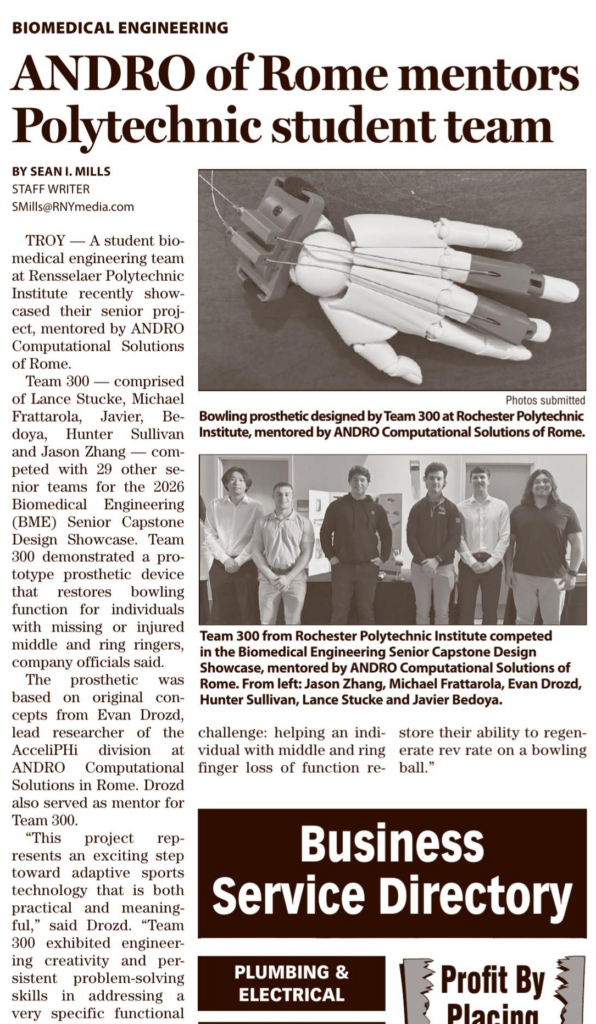
TROY, NY — The 2026 Biomedical Engineering (BME) Senior Capstone Design Showcase, sponsored by Rensselaer Polytechnic Institute (RPI), took place at the Shirley Ann Jackson, Ph.D. Center for Biotechnology & Interdisciplinary Studies (CBIS) at the RPI Campus in Troy, NY on April 28. The 29 graduating senior BME design teams presented their research posters and prototypes, demonstrating real-world healthcare technology, diagnostic systems, and clinical solutions.
Dr. Evan Drozd, lead researcher of the AcceliPHi division at ANDRO Computational Solutions, LLC in Rome, was among a group of mentors working with RPI student teams, in this case, to adapt military-rooted AI-wireless technologies to develop an assistive prosthetic device for bowlers with permanent hand or finger injuries. Drozd also recently mentored two Syracuse University Biomedical Engineering Capstone teams, one of which was awarded the top prize for a similar type of assistive device used In sports activities but that addressed a distinct set of upper limb injuries and functional immobility.
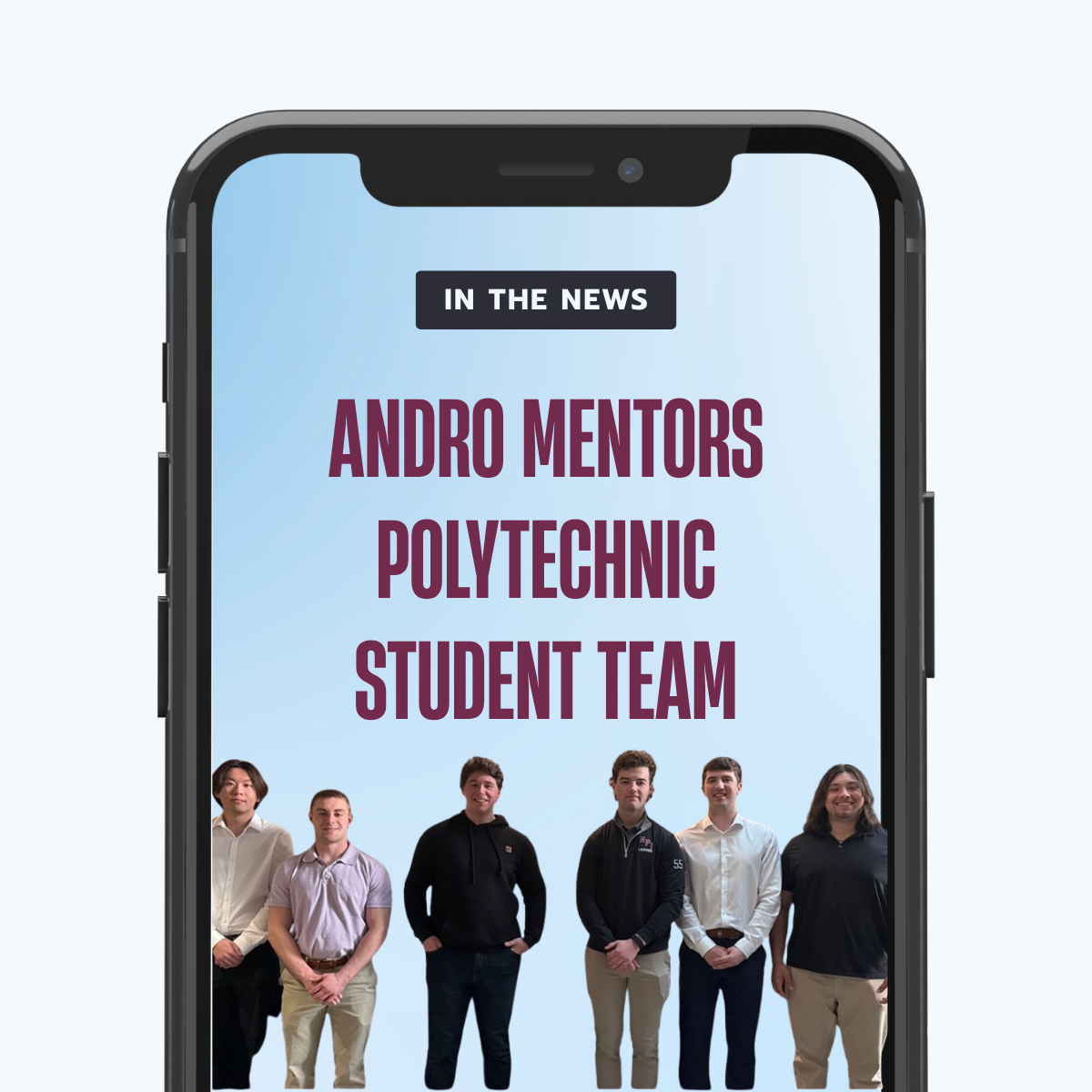
Under Drozd’s guidance, RPI’s five-member Team 300 — comprised of Lance Stucke, Michael Frattarola, Javier Bedoya, Hunter Sullivan, and Jason Zhang — successfully demonstrated a prototype of an assistive prosthetic device that restores bowling function specifically for individuals with missing middle and ring fingers.
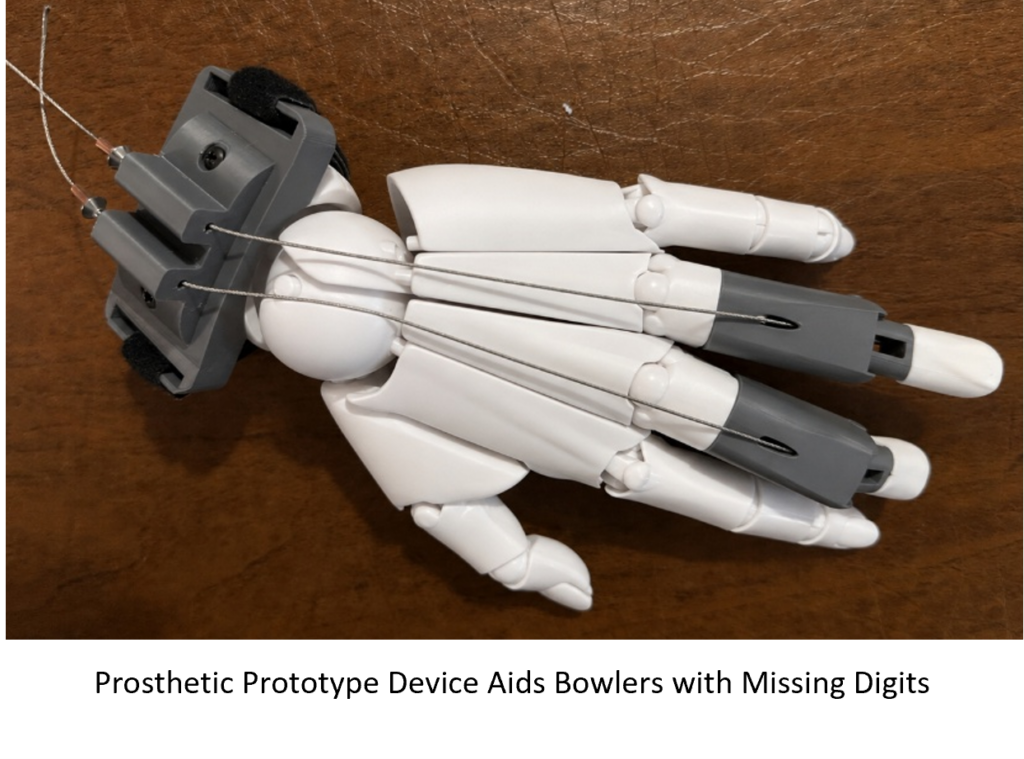
Team 300 developed a passive mechanical prosthesis based on Drozd’s original design concept. Bowlers challenged by missing digits would be better able to regain ball contact/grip and functional control, including ball release mechanics and restore their ability to produce high rev-rate performance, allowing them to compete in leagues more effectively.
Drozd, an avid bowler, participates in several leagues throughout the year in Rome and Utica. He often runs into bowlers who struggle with the sport due to a variety of hand injuries. He wanted to develop a set of prosthetics that could enable them to compete in competitive leagues with the aid of assistive prosthetics typically configured in glove-form, as sanctioned by professional bowling associations.
AcceliPHI was formed to take certain of ANDRO’s patented Artificial Intelligence (AI) and wireless technologies developed for the military and commercialize them for a range of medical technology (medtech) uses and applications. According to Drozd, AcceliPHI is about using advanced technologies to promote or accelerate states of human health and well-being.
One of the engineering challenges in the BME Capstone project specifically addressed the ability to consistently generate rotational forces on a bowling ball when the middle and ring fingers are absent or functionally impaired. These fingers are essential in producing rev rate, controlling release timing, and creating the rotational motion needed for hook action and ball performance in competition. AI was explored for the purpose of training the prosthetic to react to hand motions but required more work to be fully implemented.
Team 300 developed two major design iterations. The first used passive wrist flexion as a mechanical driver to create finger flexion, allowing the prosthetic fingers to engage with the ball during the release phase. The second iteration explored a finger-flexion-biased passive prosthesis, designed to maintain contact and grip with the ball while helping produce rotational force during release.
“This project represents an exciting step toward adaptive sports technology that is both practical and meaningful,” said Drozd. “Team 300 exhibited engineering creativity and persistent problem-solving skills in addressing a very specific functional challenge: helping an individual with middle and ring finger loss of function restore their ability to (re)generate rev rate on a bowling ball.”
The early prototype shows the potential of what passive or active mechanical prosthetic systems can offer to restore one’s ability to participate in recreational or competitive sports. While still in a proof-of-concept stage with refinements planned, the device provides a promising foundation for adaptive sports technologies and wearables for amputees and individuals with hand or other physical impairments.
Drozd envisions that future work will focus on developing a prosthetic finger system that is durable, adjustable, and marketable. The next steps per Drozd include user testing, improving comfort and fit, implementing mechanical optimizations, assessing manufacturability, and exploring business opportunities with adaptive sports equipment outlets, medtech sales force, and prospective investors.
AcceliPHI is planned for spinoff as a separate company based in Rome within the next 12-18 months.
Drozd stated that the successful completion of the BME Capstone project reflects the value of connecting engineering students with real-world biomedical and recreational rehabilitation challenges. He added, “Through this collaboration, Team 300 demonstrated how thoughtful mechanical design can support function, independence, inclusion, and return to meaningful activity despite such challenges.”
In the News: