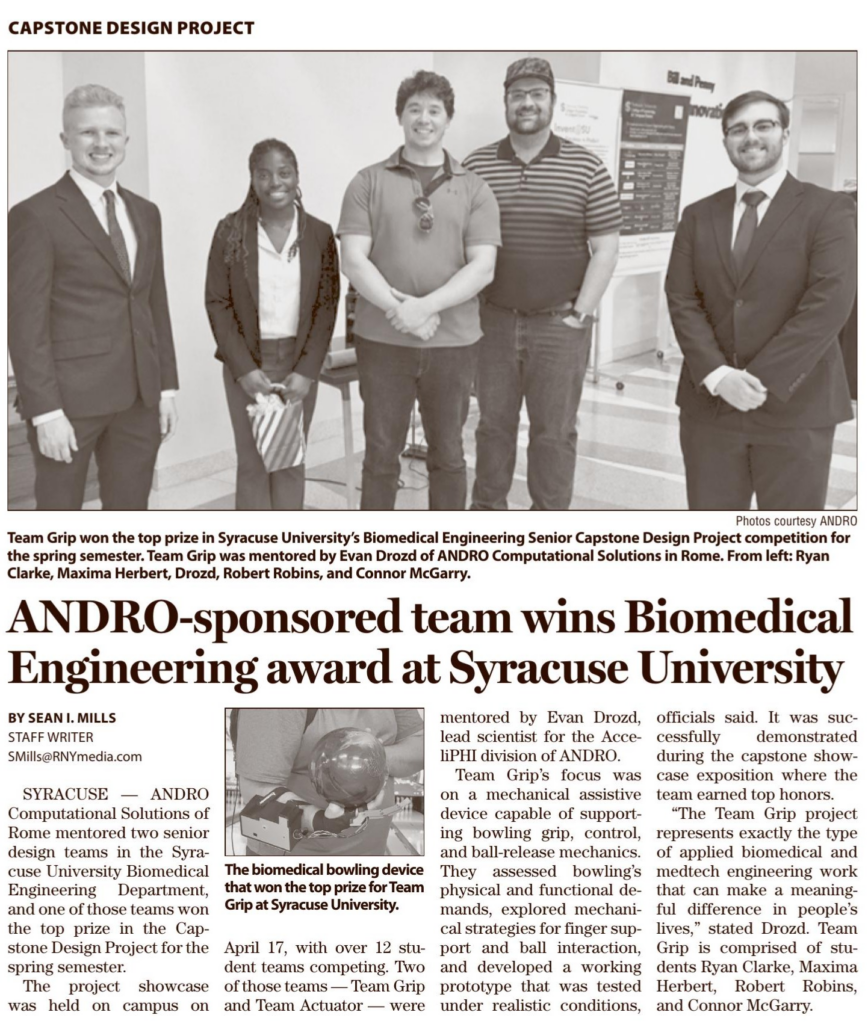
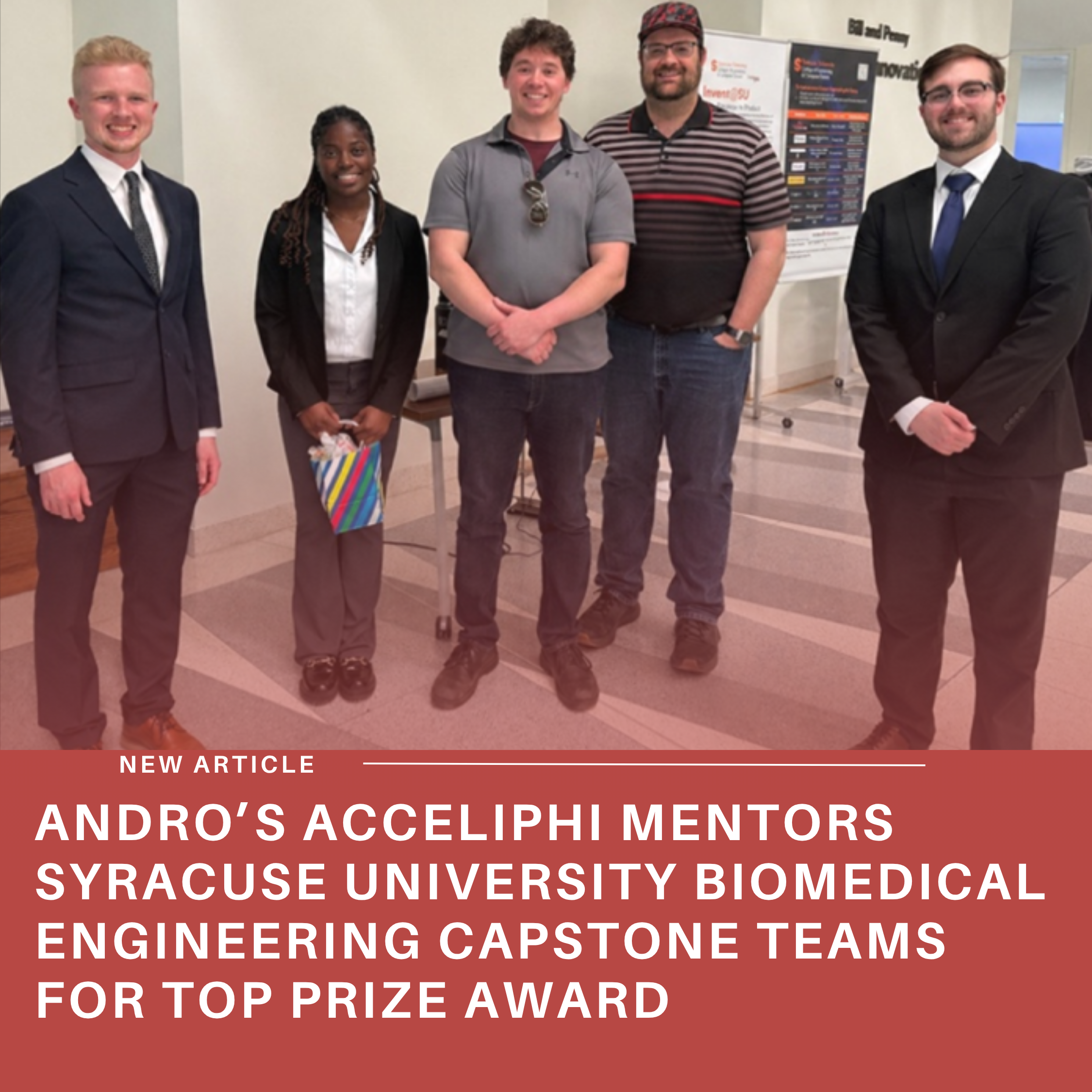
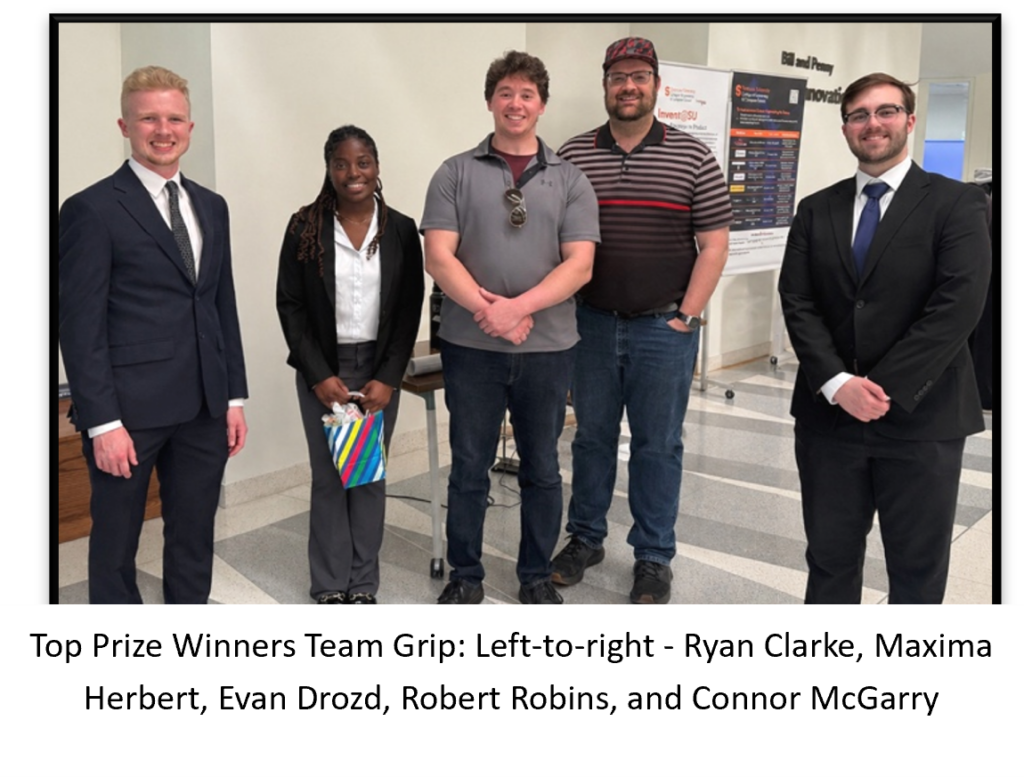
Syracuse University concluded its Biomedical Engineering Senior Capstone Design Project for the Spring semester at a showcase exposition event held at their Link Hall Atrium on April 27. The event hosted over twelve student teams competing for the Best Overall Presentation and Technology Demonstration Award. Two graduate Capstone teams—Team Grip and Team Actuator—were both mentored by Evan Drozd, Doctor of Physical Therapy (DPT) and lead scientist of the AcceliPHI division of ANDRO Computational Solutions, LLC of Rome, resulting in Team Grip receiving the top prize award.
Drozd heads AcceliPHI’s efforts to commercialize certain technologies in ANDRO’s portfolio at the intersection of wireless sensing/communications and Artificial Intelligence (AI) and to adapt them for medical technology (medtech) applications. AcceliPHI’s mission is to accelerate wellness through technology in the form of “smart” wearables and motion-assist solutions.
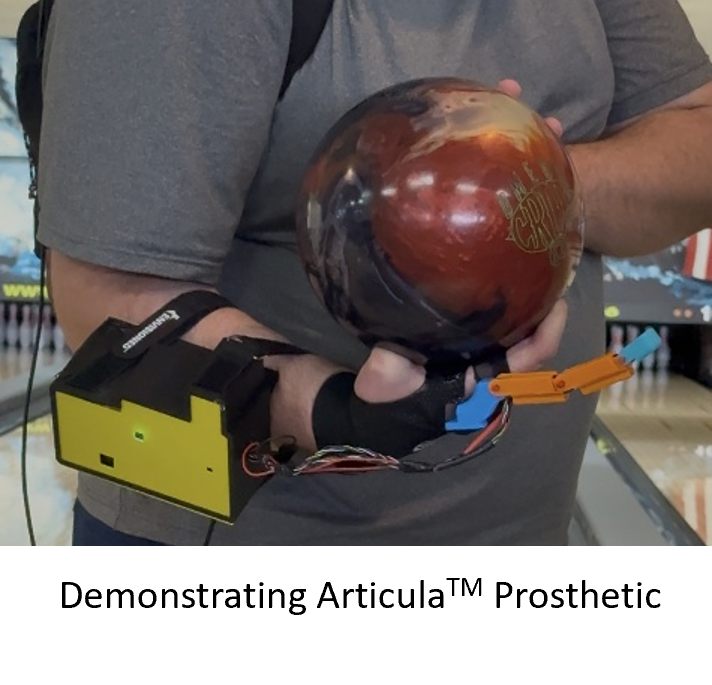
Under Drozd’s mentorship, Team Grip, consisting of Ryan Clarke, Connor McGeary, and Maxima Herbert along with Robert Robins—who helped evaluate device efficacy, successfully completed and demonstrated a proof-of-concept prosthetic finger-glove called ArticulaTM, designed to reactively restore functionality and control to bowlers missing digits or with upper-extremity imbalance. Drozd, an avid bowler himself, was inspired by the idea of a prosthetic aid that was easy to wear, affordable, and that addressed a demand for such aids in the sport of bowling. Drozd has a patent pending on the design.
Team Grip’s focus was on a mechanical assistive device capable of supporting bowling grip, control, and ball-release mechanics. They assessed bowling’s physical and functional demands, explored mechanical strategies for finger support and ball interaction, and developed a working prototype that was tested under realistic conditions. It was successfully demonstrated during the capstone showcase exposition where the team earned top honors.
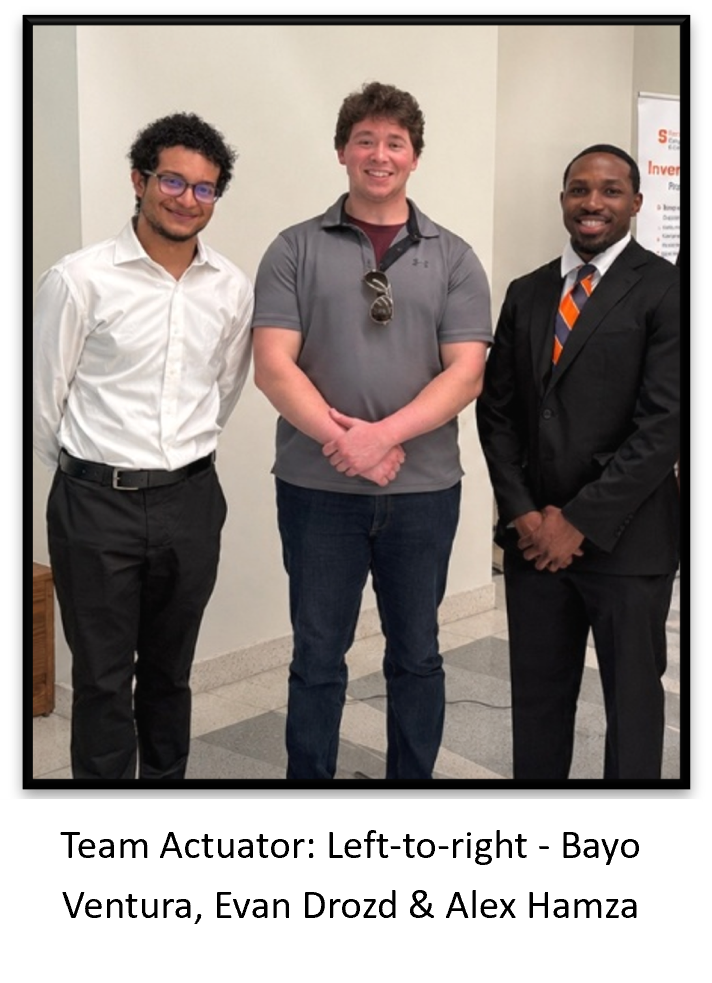
Team Actuator, comprised of Alexander Hamza and Bayo Ventura, focused had a different focus—developing a prototype actuator-assistive device intended for use in wearables and human-mobility systems. They evaluated how actuator-driven motion could be applied to rehabilitative systems, particularly those where automated controlled movement, mechanical support, and user-centered functions are essential. The original concept was based on an AI-driven electro-servomechanical actuator patent awarded to Drozd and his AcceliPHI team at ANDRO.
With ANDRO/AcceliPHI as the client and under Drozd’s direction and project leadership, the teams advanced their project from basic concept design to rapid initial experimentation and final prototyping within about 3 months.
“The Team Grip project represents exactly the type of applied biomedical and medtech engineering work that can make a meaningful difference in people’s lives,” stated Drozd. “Ryan, Connor, and Maxima demonstrated creativity, problem-solving, professionalism, and persistence in developing a device concept that could help restore access to an enjoyable activity for finger amputees and those similarly challenged.”
Drozd further added, “Team Actuator’s project represents the type of forward-thinking biomedical engineering work needed to move assistive technology into the next generation. Alexander and Bayo demonstrated strong technical curiosity, engineering discipline, and creative problem-solving while working through a challenging actuator-based design concept.”
According to Drozd, the mechanical bowling prosthetic project highlights the importance of student-led innovation in assistive technology. While still in the proof-of-concept stage, the device demonstrates the potential for future development of adaptive recreational sports equipment at an affordable price that improves quality of life, independence, participation and belonging for physically-challenged individuals.
While still in the proof-of-concept stage, Team Actuator’s work provides a foundation for future development of wearable assistive systems that may one day support individuals with musculoskeletal or neurological impairments.
AcceliPHI, currently a division of ANDRO, is planned for spinoff as a separate company based in Rome. Future work will focus on further refining both devices and bringing them to market including exploring opportunities with biomedical device manufacturers and sales teams in the Mohawk Valley region and working with potential investors and commercialization partners in the area.
Drozd and the ANDRO-AcceliPHI team extend thanks to the Syracuse University Dept. of Biomedical Engineering for the opportunity to collaborate with their capstone students on these meaningful biomedical engineering projects. Additional thanks goes to Robert Robins for providing real-world evaluation insights and ongoing feedback. Both capstone projects demonstrated how biomed and medtech engineering design can move beyond theory and into practical innovation that supports human function, mobility, and independence.